The policies in the 4-for-2°C Scenario have been selected because they meet key criteria: they can deliver significant reductions in energy-sector emissions by 2020 (as a bridge to further action); they rely only on existing technologies; they have already been adopted and proven in several countries; and, taken together, their widespread adoption would not harm economic growth in any country or region. The four policies are:
Adopting specific energy efficiency measures (49% of the emissions savings).
Limiting the construction and use of the least-efficient coal-fired power plants (21%).
Minimising methane (CH4) emissions from upstream oil and gas production (18%).
Accelerating the (partial) phase-out of subsidies to fossil-fuel consumption (12%).”
This post is by Dr Bruce Tofield, associate consultant at the Adapt Low Carbon Group, University of East Anglia.
In launching Next steps for shale production, energy minister Michael Fallon said that fracking “is an exciting prospect, which could bring growth, jobs and security”. There is, however, great concern about the damaging local environmental impact of fracking in Britain. Less remarked upon is fossil fuel lock-in, highlighted recently by Rachel Cary. As Michael Liebreich, CEO of Bloomberg New Energy Finance, has pointed out “If the UK ever becomes dependent on shale gas, it will never be able to kick the fracking habit.”
Richard Leese, leader of Manchester City Council, continually argues, Manchester City Council cannot do anything without the other councils within Greater Manchester doing so as well. I attended the Triodos Bank AGM (Annual General Meeting) in Bristol the other month and heard some inspirational stories from people including those from Bristol. The Mayor of Bristol was one of those who spoke about what had been achieved and what they are still trying to achieve. There was an atmosphere of being part of the solution and of success. This feeling of success, came on top of my feeling, things are getting done in Bristol, after my visit for the Triodos Renewables Fund AGM. I had posted earlier about my visit to the AGM: Bristol-and-Wessex-Water. Not the constant complaints why it cannot be done or that it is somebody’s fault, they constantly emanates from Richard Leese. How he can be considered a leader, is beyond me, he is unfit to be in charge of an empty shopping trolley, in an empty car park. The article reinforces the fact, that Bristol is moving forward on being green and sustainable:
A blog from Friends of the Earth about the fallacies behind ‘fracking’ and the ‘Green Deal’. The Government should be doing more to reduce energy consumption and investing more money into real renewables.
As an investor in Triodos Renewables Fund, I decided to go to Bristol to attend the AGM (Annual General Meeting) of the fund. The meeting took place on Saturday, 15th June and had decide to spend the weekend in Bristol. This was my second AGM, I had attended, my first being two years ago when it was held at Ness Point, Lowestoft, site of one of the funds wind-turbines.
That weekend was also the start of Bristol’s Big Green Week, which leaves Manchester’s green events in the shade. The Friday I arrived, it was announced that evening, that Bristol had been elected to be European Green Capital for 2015. I did noticed their City Centre did seem cleaner and greener than Manchester City Centre, with plenty of mature trees still standing.
View along St. Augustine’s Way, towards the Cenotaph.
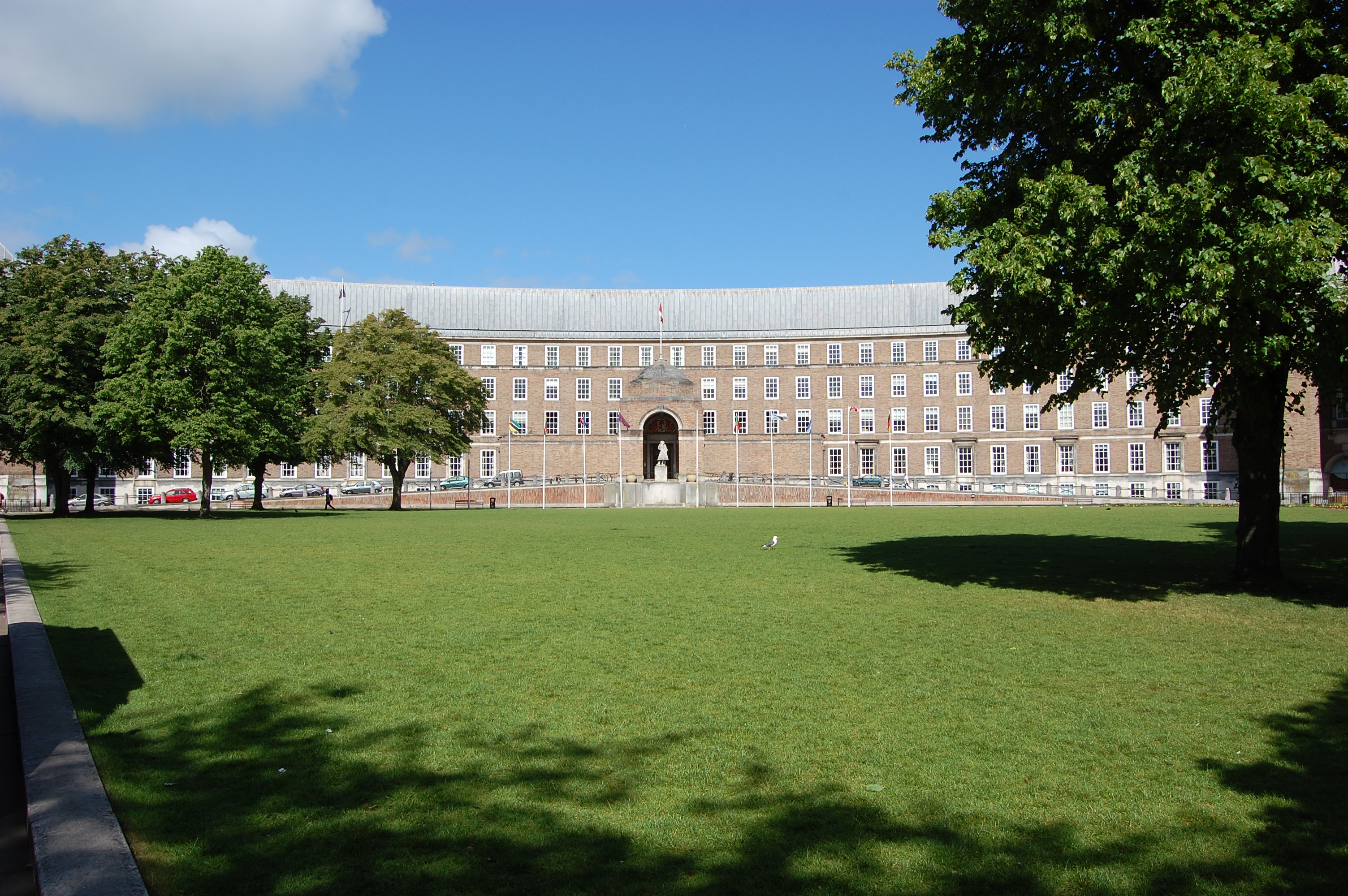
On the Saturday morning I made my way down to the Triodos Bank offices. I found the walk pleasant, not just because of the views but also of the pedestrian and cyclist friendly attitude of the motorists. And the scene outside Bristol’s Council’s offices beats Manchester’s any time in my view.
Bristol City Council offices
At Triodos’s offices we were informed they had solar PV in place on the roof and rainwater was harvested. Unfortunately, the EA (Environment Agency) had occupied the offices next door first and they were the beneficiaries of the harvested rainwater. After the main business of the AGM, we had a question and answer session. One of the questions was about opposition to wind-turbines. A member of the board, stated only one site had received any complaints, which was Kessingland, a site a visited two years ago. The complainant wrote, they could not see or hear the turbines, in fact knew nothing about them till they had read about them in the local paper. The board member did stress, that they still took this complaint seriously and took steps to mitigate any adverse impact. The Governments real intentions towards renewables, especially Eric Pickles stated support for those opposed to onshore wind.
After lunch, we took a coach to Avonmouth and Wessex Water waste water treatment plant (sewage farm). After donning hard hats and high-vis, we assembled in a training room to be given a presentation by Mohammed Saddiq of GENeco. He explained the board of Wessex Water wanted to reduce their energy consumption and reduce their carbon footprint. Mohammed, stated GENeco was set up to explore the options, looking into energy efficiencies and into trying to be energy self-sufficient. You need to do both, to achieve the aim of reducing greenhouse gases and moving away from a fossil fuel economy.
Originally the treated sludge waste from the sewage treatment plant, would be taken by local farmers, for a price. GENeco, decided to put this sewage sludge through a two-stage bio-digester to produce biogas. This left a rich compost which the company now sold to local farmers. In fact, the company employs a team soil biologists to advice farmers on exactly how much of this bio-fertiliser they need, to improve their soil. 220,000 tonnes a year are supplied by GENeco to farmers, as an alternative to fossil-fuel derived fertilisers.
He did go on to mention a post-graduate working for them, who had suggested he could use the grits, rags and plastic instead of it going to landfill. The screenings as they are called are composted and used of remedial landscaping and the plastics separated out and sent to an energy-from-waste plant (I do not know which one and what process it uses). Their claim is they are zero waste, as no waste is sent to landfill.
As well as sewage sludge being processed in the bio-digester plant, they now collect food waste and use this as well. The biogas is used in CHP plants to produce energy and heat. The heat is used to improve the efficiency of the plant and enough electricity is produced to be able to export some to the national grid. The even produce excess biogas, and have converted some of their vehicles to run on it,not just their promotional vehicle.
The Big Bug, biogas powered vehicle.
They are producing 42 GWhr/year of electricity, exporting biogas, produce fertiliser and compost and even send treated waste water to a power station for use as cooling water. And all this was accomplished in 31/2 years. What has Manchester City Council accomplished since announcing it’s Manchester – A Certain Future, in December 2009?
So why was Triodos Renewables investors here at Wessex Water waste water plant? During GENeco‘s review of options, they had applied for planning permission for 4 wind-turbines, that was approved. As, they were already energy sufficient, they had offered Triodos Renewables to chance to build and operate the wind-turbines. And that was the primary reason we were there, to look at the locations for our 4 new turbines.
Pilings in place for Turbine 3 at Wessex Water, Avonmouth plant.
These four turbines will give Triodos Renewables an additional 8.2MW of capacity to the already 43.25MW of installed capacity. A very ethical outcome for all involved.:-)
Another article about the negative environmental impacts of ‘fracking’. The method of using high hydraulic pressure to fracture gas shale or coal-seams to extract methane (natural gas).
A summary of a report debunking the myth of Nuclears environmental claims. Nuclear has a large carbon-footprint that proponents of nuclear never talk about. It also would mean this country would be dependant on imported ore that is becoming scarce, 1-1.5% per tonne of material mined. The UK has spent over £50 billion on building and running nuclear plants and it will cost an additional £50 billion to de-commission redundant plant. This dwarfs the amount of money spent of renewables and the amount of money the fossil fuel companies avoid through tax-breaks, given them by the UK Government.
On the 8th and 9th May 2013, Manchester Central hosted the GreenbuildEXPO, which was sponsored by Manchester City Council, which I attended on the 8th. On initially walking around the various stands, the one thing that struck me was, that it was all geared up for the Green Deal. I did overhear someone saying that Green Deal advisor’s must tell people that they receive a payment of £150, I wonder how many do?
The opening speech was by Ashley Crumbley, CEO of Wigan and Leigh Housing Company and on the board of Greater Manchester’s Low Carbon Economy Board. He stated how great it was that the Government is going down the road of supporting Biomass (Why? Biomass is neither green or sustainable: Biomass myths). Then he talked about Greater Manchester’s Carbon Hub of which he was a member and of the leadership of Sir Richard Leese (What leadership, he is taking part in a government initiative and it was Nottingham that led the way on Climate Change over a decade ago. That is playing at ‘follow the leader’ not leadership). He then went on to talk about Kevin Anderson, who keeps scaring us (as if what Kevin was saying was some sort of joke). He mentioned that 2 degree C, is the limit between dangerous and very dangerous climate change! And that Manchester is working to accelerate into reducing carbon emissions (where?). He then went onto state the business case is still not clear. Executives do not think there is clear guidance and also the finances are not there and of the cost of borrowing. (What happened to Leese’s leadership? If you save energy, you save money, simple and cost of borrowing when it is the lowest it has ever been, except those on the Green Deal, who is he kidding). He than mentioned Greater Manchester is the second largest growing hub outside of London. He lastly mentioned a Japanese organisation (what happened to Leese’s leadership, that a foreign organisation has to be brought in, to lead? What about all the innovation that is supposed to be happening in Corridor Manchester and Manchester Science Park?) NEDO, who are setting up a eco-community trial, maybe in 2014?
I have thought for some time this ‘Green Deal’ only benefits large companies, especially the big 6. People are struggling to pay their energy bills and many in Manchester suffer from fuel poverty. Going to the GreenBuild Expo in Manchester only reinforced this impression. Then I read a letter in the Architects’ Journal’s Annual Green issue (28.02.13): Green Deal: costly…
‘Regarding your article about the Green Deal (AJ 31.01.13), I’ve felt like a little boy who told the Emperor he was in his underpants. I have worked as an architect on all types and sizes of projects, both public and private sector, I have recently attended many Green Deal-related workshops and seminars. I also sit on the Small Practice Committee at RIBA, where the Green Deal has been discussed at length. Here are my thoughts on the topic: The Green Deal seems to be a very expensive way to fund improvements, with the only beneficiaries being the City (via high-interest loans), the government (collecting VAT and meeting carbon reduction targets), assessors, suppliers and installers (making normal profit margins) and private energy firms, which will be almost encouraged by the government to increase rates to make the ‘Golden Rule’ work. The Green Deal appears to be aimed at people who do not have the money to pay for improvements up-front (which would be cheaper), but the government assumes these same people will have enough money to pay vastly higher energy bills. Property values could be adversely affected by Green Deal alterations and outstanding debt that will be attached to the property. I would not want to buy a house with a charge on it, so assume no one else would, either. My guess much of the equipment being promote now could be obsolete in less than 5 years – long before it is paid for. I have not heard mention of Building Regs Approval of Green Deal improvements. I have recently…’ Marianne Davys, Marianne Davys Architects.
I can only agree with Marianne’s comments but go further and say the emperor is absolutely stark naked and possibly stark raving mad.
– Does New York State need — for its own sake or the environment’s — to be an energy island? A lot of economists, and environmental analysts, would say no.
Yes it does need to be an energy island, on economic and environmental grounds, something environmentalists have been calling for. A move away from large centralised power stations, fossil fuelled or nuclear, and to more smaller, localised power sources: Sustainable_community_energy_system. Case studies of Sustainable Woking can be found at: Sustainable Woking case studies. It took just one council official to drive this initiative through back in 1991 and yet Manchester – A Certain Future since its fanfare launch in 2009, has achieved exactly, nothing! It is amazing what can be achieved with some effort and enthusiasm.
Though I disagree with some of the points the reviewer makes during his review of Extreme Environment. I think, he has highlighted the repeated nonsense of those who think ‘business-as-usual’ scenario is the one we should follow and environmentalist are just a bunch of ‘Nazis’. The fact that Ivo Vegter uses Monckton as a source of knowledge to attack environmentalist, should give a clue to the his mindset. There are points environmentalist can learn both from the book and the reviewer’s blog, for them to develop their case more hard-cast and understandable to all.

 This post is by Dr Bruce Tofield, associate consultant at the Adapt Low Carbon Group, University of East Anglia.


 patricktsudlow